Parking
Parking often raises questions. This page includes the basic principles of safe and lawful parking. The Finnish Road Safety Council does not comment on individual cases from the perspective of penalties, fines, or guilt. If you would like to know how to park in a specific location, contact the parking control for the area in question.
Park and depart safely
A vehicle may not be stopped or parked in a way that endangers the safety of other traffic or inconveniences it. Stopping or parking is also always prohibited when it causes unnecessary disruption to traffic.
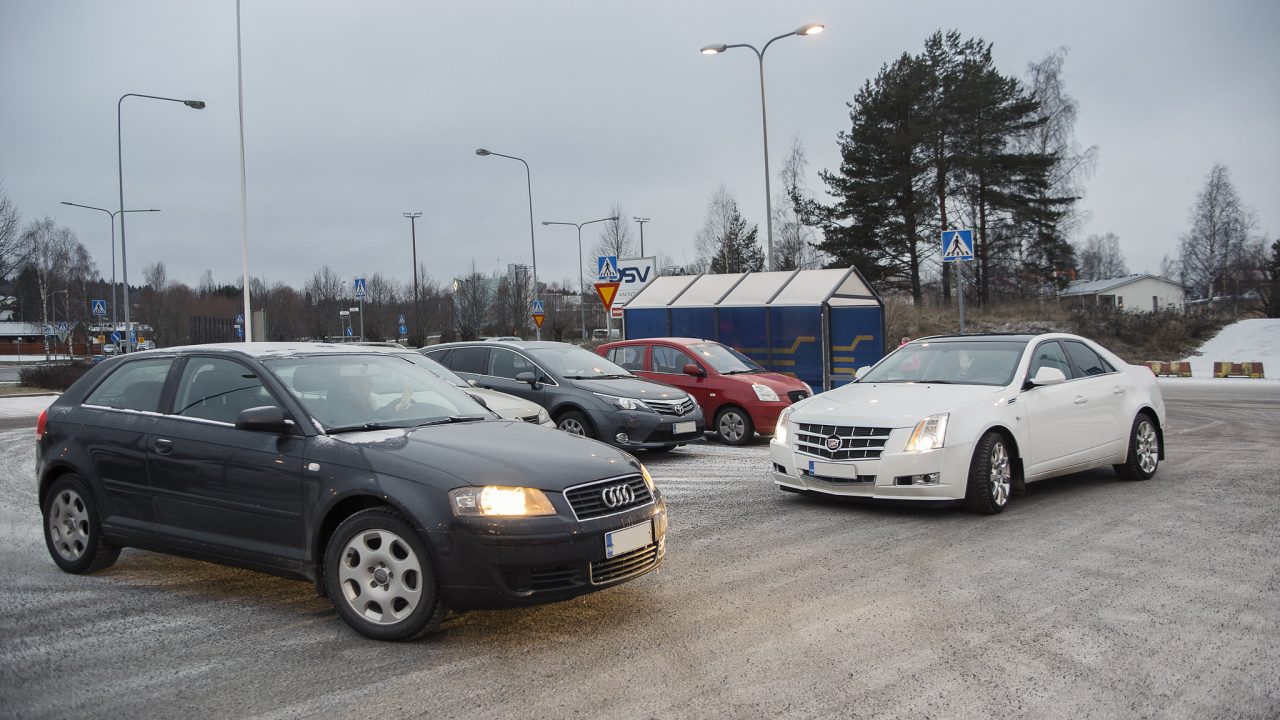
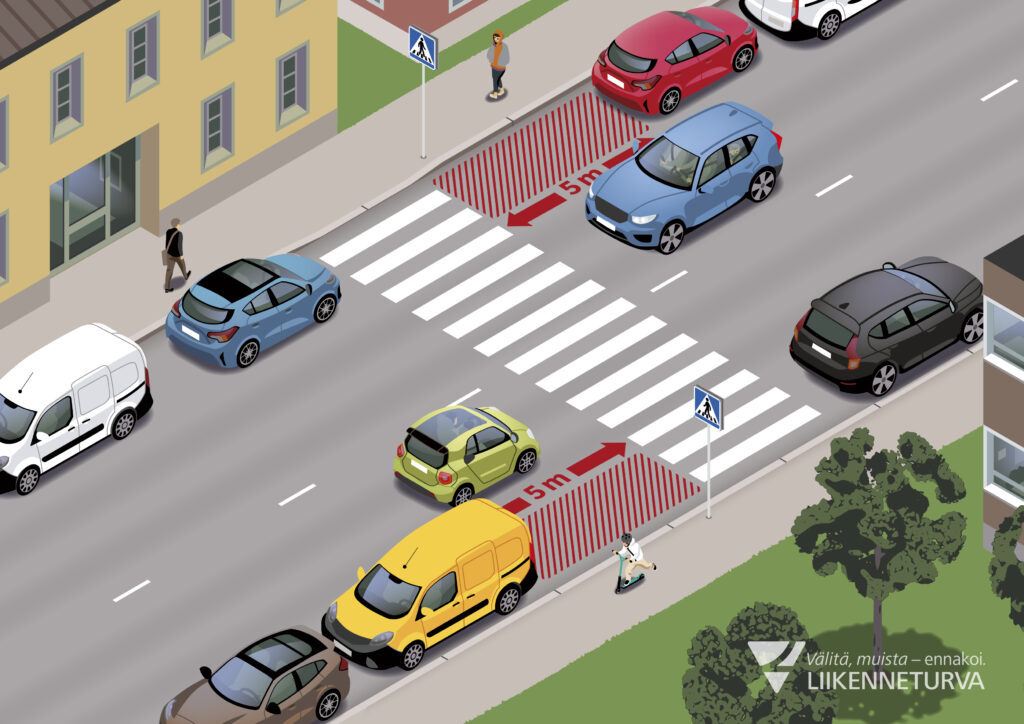
Parking and stopping a car is specifically prohibited on pavements, pedestrian crossings, cycling routes, cycling route extensions, five metres before pedestrian crossings, intersecting cycle routes or intersecting cycle route extensions, and intersections. This prohibition also applies to such areas as tunnels, roundabouts, motorways, bicycle lanes, and bus lanes.
However, stopping is permitted in the aforementioned locations due to a mandatory traffic obstacle, compliance with the obligation to give way or an emergency.
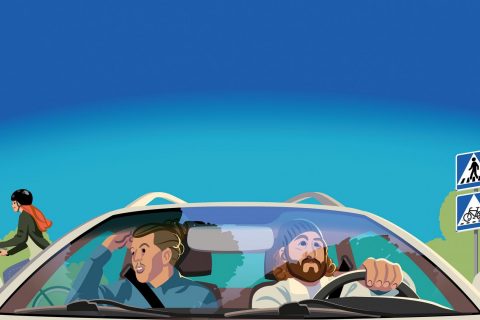
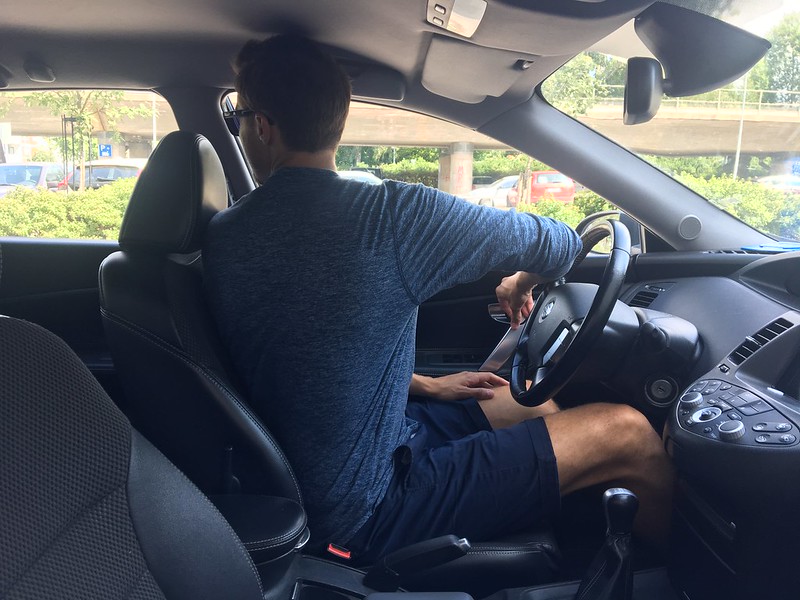
When you have parked your vehicle in the correct manner, make sure that you can get out safely before you do so. For example, when parking along a street, check whether any cyclists or other traffic are approaching your vehicle from behind before opening the door. Here you can use the Dutch reach method, where you open the car door using your right hand. In this way, your body and head automatically turn prompting you to look back.
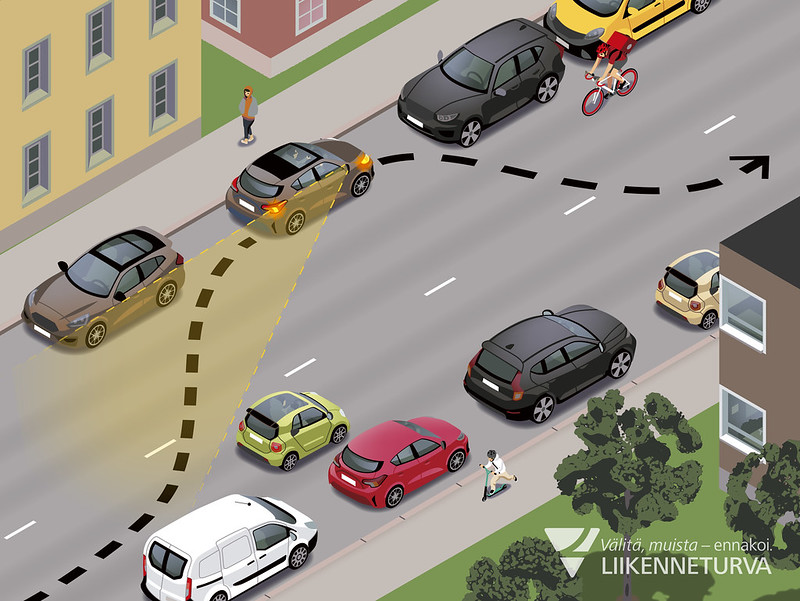
When leaving a parking space, you must observe your surroundings carefully and give way to others. Take particular care when backing out of a parking space. Parking a car in a manner that ensures you can leave a parking space looking forward is a good way to improve safety.
Parking allowed on the left side in population centres
The Road Traffic Act also allows parking and stopping on the left side of the road on two-way streets in population centres. Drivers may park on the left side of the road only when it does not endanger or inconvenience other road users.
Use this option with caution. Be aware, that while the situation may have been favourable when you were parking, the situation may be completely different due to e.g. busier traffic, when you are leaving. Also note the visibility from your car to the rear. It may be difficult to see what’s behind your vehicle especially from a van or truck. Keep in mind that you must give way to oncoming vehicles or any vehicles behind you.
When parking on the left side of the road, you must take into account the distance of five metres to any pedestrian crossing in accordance with the actual direction of travel.
What is the difference between parking and stopping?
Parking means that a vehicle stands in place with or without a driver, excluding short-term standing for the purpose of getting in or out of the vehicle, or loading or unloading the vehicle.
Stopping is when a person gets out of or gets into a stopped car, or a vehicle is loaded or unloaded. In practice, a stop can also include waiting for someone you are picking up for a short period of time, but not, for example, waiting for someone to pop into a store. Whether the driver is seated in the stopped vehicle or whether the engine is running does not distinguish between stopping and parking.
The police have instructed on short-term loading or unloading as follows:
- On a road where stopping is prohibited: Stop on the pavement.
- On a road where parking is prohibited: Stop in the carriageway.
- On a road where parking is permitted: Stop in the carriageway next to the parked cars.
There are separate signs prohibiting stopping (Opens in a new window) and parking (Opens in a new window).


Stopping on a pavement or cycle route
Parking and stopping on a pavement or cycling route often raises questions and starts debates. A bicycle or moped may be stopped and parked on a pavement or a cycling route, but this is, as a rule, prohibited for other vehicles. However, there is an exception to the rule: special care may be taken to stop for a short period of time on a pavement or a cycle route when a person gets in or out of the vehicle, the vehicle is loaded or unloaded – if there are no other suitable stopping places in the vicinity and there are compelling reasons for stopping.
A stopped vehicle may not disproportionately impede traffic on a pavement or a cycle route. The driver must in this case remain in the vicinity of their vehicle and, if necessary, move the vehicle to a place where it will not interfere with other traffic.
Stopping at a bus stop
A vehicle may be stopped at a bus stop if this can be done without blocking bus traffic. Although a stopping prohibited traffic sign (C37) prohibits stopping on the side on which it is placed, it does not apply to stopping at a bus stop as permitted by the Road Traffic Act.
Parking is not permitted at a bus stops.
Courtyard, pedestrian and bicycle streets
Parking a passenger car on a courtyard street is only permitted in a separately marked parking area. However, a vehicle with a parking ID for disabled persons may be parked outside the designated parking space if it does not unreasonably hinder movement on the courtyard street.
Parking and stopping of a motorised vehicle on a pedestrian street is prohibited, with the exception of stops related to service traffic when service traffic is permitted as indicated in traffic signs.
Parking a vehicle on a courtyard street is only permitted in a separately marked parking area. However, a vehicle with a parking ID for disabled persons may also be parked elsewhere on the carriageway of a bicycle street if it does not cause unreasonable inconvenience. A bicycle and a moped may also be parked on a pavement on a bicycle street if it does not unreasonably hinder movement on the pavement.
Municipal parking control and parking in a private area
A municipality’s own traffic planning unit is responsible for matters concerning the traffic environment of the municipal street network, traffic signs in population centres, location-specific traffic solutions and road maintenance. Municipal parking control also monitors compliance with parking bans in road traffic areas. It is a good idea to contact municipal parking control if you are concerned about something related to parking in a certain location.
Parking in a private area without the permission of the property’s owner or occupant is prohibited as a rule. Parking in private areas is often supervised by private parking control companies. Incorrect parking in a private area will usually result in a supervision fee imposed by a private parking company, the size of this fee and instructions concerning it will be posted in connection with the parking area. If there is general traffic in the area and the area is therefore a road referred to in the Road Traffic Act, the parking prohibition is usually indicated by a traffic control system. A municipality must give permission for such a system to be installed. The prohibition imposed in this manner has legal effect and, consequently, municipal parking control also has competence in the area in accordance with the Parking Enforcement Act (727/2017).
If you have any questions about parking in a private area, you can ask the owner or occupant of the property in question or the party responsible for parking control in the area.
No waiting zone
The No waiting zone traffic sign is used where parking is prohibited in an indicated area. The sign is placed along an area’s entrance streets of and its effect extends until a separate sign ends the prohibition. In other words, parking is prohibited as a rule in the area bordered by the signs , but separate traffic signs may be used within the area to specify otherwise. Within the prohibited area, parking can only be permitted with a separate parking permit.
Indicating parking start time
If the maximum parking time is restricted and the obligation to use a parking disc is indicated by traffic signs, a vehicle may not be parked without a parking disc or other appropriate means to indicate the time of arrival. However, the time of arrival does not need to be indicated in a parking area subject to a fee or if the obligation to use the parking disc has not been indicated by a traffic sign.
A parking disc or other means of indicating the time of arrival shall be placed in a visible place inside the windscreen of the vehicle during parking so that the start time of parking is clearly legible from the outside.
The start time of the parking is set as the time when the vehicle is parked. The start time can also be as The full or half-hour following the start of parking. So, if you park at 10.40, set the time on the disc to 11.00. If you park at 11.05, set the time on the disc to 11.30.
If the obligation to use a parking disc ends at 17.00 and you park at 16.10, the start time will still be entered as above, i.e. at 16.30. When the obligation to use a parking disc continues the following morning, a new permitted parking period (e.g. 2 hours) begins.
You do not need to use a disc or any other method of indicating parking start time if you are parked during a time that is entirely outside the period of validity of the obligation to use the disc.
Check any supplementary panels carefully
Supplementary panels are often placed in connection with signs that permit or prohibit parking. These provide essential information about parking in the area in question – the sign provides a rule, the supplementary panels provide details. For example, supplementary panels can be used to indicate the area in which a sign applies, a parking method, a parking time restriction, the obligation to use a parking disc and if parking is subject to a fee, as well as the period of validity of any of these on weekdays, Saturdays, Sundays and holidays.
Alternating day parking
Alternating day parking signs on the streets mostly serve maintenance tasks, such as snow ploughing and moving of vehicles. If a no-parking sign has one white vertical in the middle, it indicates that parking is forbidden on the odd days of the month on the side of the street where the sign is installed.
Correspondingly, if the sign has two white lines in the middle, this means that parking is forbidden on that side of the street on even days of the month. If the restriction is only valid for part of the day, the times are indicated with an additional sign. If there is no supplementary panel, the restriction applies from 8 in the morning to 8 in the morning the following day.
Most common mistakes made in parking
Parking violations are often caused by thoughtlessness or forgetfulness. For this reason, it is a good idea to reserve enough time for your journey so that you’ll have enough time to park your car correctly and safely at the destination – even in a place that is not familiar to you in advance.
The most common mistakes made in parking include:
- Incorrect use of the parking disc (e.g. wrong time set) or failure to indicate the start time of parking in general.
- Incorrectly estimated fee (too low) for a paid parking space.
- Intentional incorrect parking if there is no space available in permitted spots.
- A car is parked in an area with a no-parking sign.
- A car is parked on the carriageway of the property, for example on a rescue route.
- A car is not properly parked in the parking space, for example, it has been driven between the squares or on top of a line.
- Parking in an intersection area or too close to a pedestrian crossing.
Source: Cities of Turku and Helsinki
Motorcycle parking
- As a rule, motorcycles are parked just like cars.
- Unlike a moped and a bicycle, a motorcycle may not be parked on a pavement or on pedestrian and cycle routes.
- A motorcycle may not be parked in a bicycle parking space.
- You do not need to use the parking disc or other means of indicating the start time of parking, but the same time limits apply parking motorcycles as to cars.
Parking quadricycles, ATVs and tractor ATVs
- As a rule, quadricycles, ATVs or tractor ATVs are parked just like a car.
- If the parking space has been allocated to a certain group of vehicles, such as passenger cars, then no other vehicle, such as a quadricycle, ATV or tractor ATV, may be parked there.
- Unlike mopeds or bicycles, quadricycles, ATVs, or tractor ATVs may not be parked on pavements or on pedestrian and cycle routes.
- A quadricycle, ATV or tractor ATV may not be parked in a moped or bicycle parking area.
- When parking quadricycles, ATVs and tractor ATVs, the same time restrictions apply as to cars. The start time of parking must be indicated.
- When parking a quadricycle, ATV and tractor ATV in a parking spot subject to a fee, the driver must pay the fee in the same way as the driver of a car.
- Various mobile applications for parking are particularly handy for ATVs and tractor ATVs, as they often help in avoiding the use of a paper parking tag.
Parking ID for persons with disabilities
If a vehicle has a parking ID for persons with reduced mobility (in the former Road Traffic Act, a parking permit for persons with disabilities), the vehicle may be parked in public areas:
- In parking spaces designated for disabled drivers marked with a wheelchair sign.
- In parking spaces subject to a fee without payment.
- In areas where parking is forbidden as indicated with a traffic sign (“no parking” or “no waiting zone”).
- For a period longer than the limit, in a parking space where the maximum parking time is limited as indicated in traffic signs. The duration of parking is not specified in more detail in the law.
When parked, the parking ID must be placed in a visible place in the vehicle inside the windscreen where it can be read from the outside. There is no need to indicate the start time of parking. However, when parking, the driver must ensure that the vehicle does not inconvenience other traffic.
However, a vehicle may not be parked in a location designated as a parking space for a certain group of vehicles, such as trucks, taxis or buses, as indicated in a traffic sign or supplementary panel. For example, if there is a supplementary panel “does not apply to taxis” with a “no waiting zone” sign, the space is only intended for parking taxis, and you are not allowed to park with a parking ID for persons with disabilities.
A vehicle may also be stopped without payment in a parking space subject to a fee if the vehicle is a taxi or an accessible taxi traffic and is picking up or dropping off persons with disabilities.
Practices often more diverse in private areas.
Sanctions
In most cases, violations of prohibitions and restrictions that apply to stopping and parking a vehicle will result in a parking fine. If a parking violation has caused or could cause serious danger or harm, the consequences may be more severe. A parking fine will also be imposed in cases where provisions on the use of a parking disc have been violated. The Finnish Road Safety Council does not comment on individual cases from the perspective of penalties, fines, or guilt.
If you have questions
If you have any questions about parking, you can contact parking control in your area.